
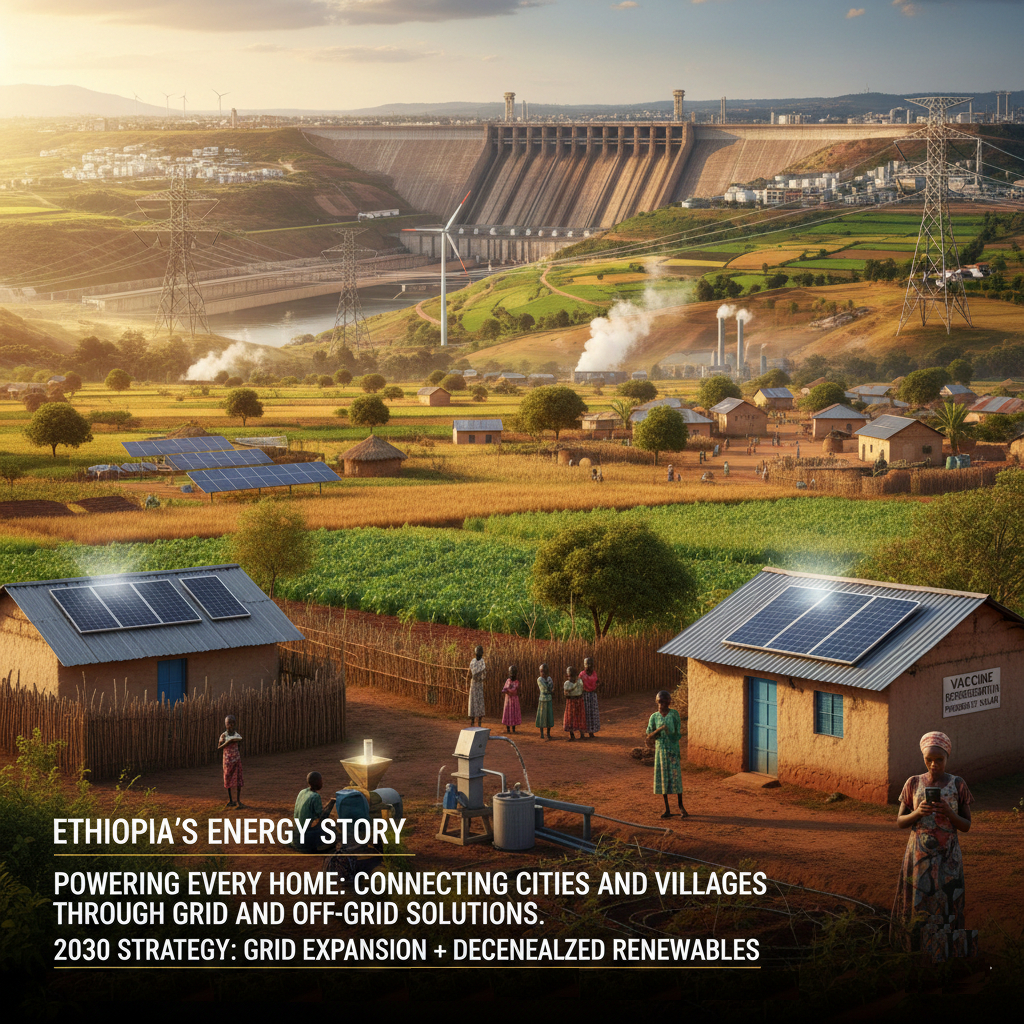
Ethiopia’s energy story is no longer just about building dams – it is about lighting every home, powering every clinic, and fueling every enterprise.
According to the Ethiopian Energy Access Survey 2025, conducted in collaboration with the World Bank, 65% of households had access to at least one source of electricity as of January 2025. Of these, 29.3% were connected to the national grid, while 35.7% relied on off-grid solar solutions.
However, only 44% of citizens benefited from a basic level of electricity service -highlighting the gap between access and reliability. By 2026, overall access has risen to approximately 55% of the population. Yet universal electrification remains an ambitious and urgent goal. To meet the demands of a growing population and expanding industrial base, Ethiopia has adopted a bold 2030 strategy built on two parallel paths: large-scale grid expansion and decentralized off-grid solutions.
Strengthening the Backbone: Expanding the National Grid
The national grid remains the foundation of Ethiopia’s energy system. In this centralized model, electricity is generated at large-scale plants – such as the Grand Ethiopian Renaissance Dam (GERD) – and transmitted over high-voltage lines across vast distances. Substations then step down the voltage and distribute power to cities, towns, factories, and institutions.
For high-demand areas, grid electricity remains the most reliable and cost-effective option.
Under the revised 2030 roadmap, Ethiopia aims to achieve 75 – 80% electrification nationwide. Approximately 70% of new connections are expected to come from grid expansion and intensification. This includes:
- Extending thousands of kilometers of transmission and distribution lines;
- Connecting peri-urban and rural communities located within 25 km of existing infrastructure;
- Modernizing aging networks to reduce system losses, which currently around 20% in distribution.
Reducing technical losses alone could unlock significant additional power without building new generation capacity.
Reaching the Unreached: The Rise of Off-Grid Solutions
For remote communities where extending the grid is geographically difficult or financially prohibitive, decentralized systems offer an immediate and practical solution.
Off-grid infrastructure includes:
- Mini-grids serving small villages
- Stand-alone solar home systems (SHS)
- Solar lanterns and hybrid renewable systems
By 2030, off-grid solutions are expected to serve 25 – 30% of the population. While earlier strategies envisioned higher off-grid shares, the current approach views off-grid technology as both a permanent solution for isolated communities and a pre-electrification bridge for areas awaiting future grid expansion.
Through initiatives such as ADELE (Access to Distributed Electricity and Lighting in Ethiopia), the government is partnering with the private sector to distribute solar systems using innovative Pay-As-You-Go (PAYG) financing. This model enables rural households, especially farmers, to afford clean lighting, phone charging, and small appliances without heavy upfront costs.
But off-grid energy does more than power light bulbs. Solar-powered water pumps support irrigation. Refrigeration preserves vaccines in rural health posts. Small machinery enables agro-processing. In this way, decentralized energy becomes a catalyst for local economic growth and improved public services.
Diversifying for Resilience: Beyond Large-Scale Hydro
Ethiopia has long relied heavily on hydropower – accounting for nearly 95% of generation in previous years. While hydro remains the backbone of the system, climate variability has highlighted the importance of diversification.
By 2030, Ethiopia plans to deploy over 300 MW of solar PV capacity alongside expanded mini-hydro rehabilitation. The country’s average solar irradiance of 5.2 kWh/m² per day makes solar energy highly viable, particularly in eastern and southern regions.
Mini-hydro plants, utilizing Ethiopia’s numerous river basins, offer localized and climate-resilient alternatives. Wind and geothermal projects further strengthen grid stability and reduce vulnerability to seasonal rainfall fluctuations.
This diversified energy mix is essential to building a climate-resilient infrastructure capable of sustaining economic growth even during drought periods.
Challenges and Opportunities Ahead
With total installed generation capacity approaching 10,000 MW in 2026, Ethiopia’s power sector has entered a new era. However, major challenges remain:
- High last-mile connection costs;
- Foreign exchange constraints for importing solar components;
- Technical losses in distribution networks;
- Financing large-scale infrastructure expansion.
Despite these hurdles, the full operationalization of GERD and an improved regulatory framework for private sector participation position Ethiopia as a rising regional energy hub.
Success will depend on the synergy between large, state-led grid investments and agile, market-driven off-grid innovation.
The Central Role of Ethiopian Electric Power (EEP)
EEP generates bulk electricity, operates high-voltage transmission networks, and manages the country’s largest renewable energy projects – including hydro, wind, and geothermal plants. As the backbone of the national system, EEP ensures that power generated at massive dams and wind farms reaches industries, households, and neighboring countries.
Today, EEP’s focus extends beyond expansion to stabilization. By diversifying energy sources and strengthening transmission infrastructure, the institution is reducing vulnerability to seasonal rainfall and building a more balanced energy portfolio.
Ultimately, Ethiopia’s journey to universal electrification by 2030 is not merely about infrastructure – it is about opportunity. Every new connection represents a student who can study at night, a clinic that can store medicine safely, a farmer who can irrigate crops, and a factory that can create jobs.
Powering Ethiopia is not just a technical mission. It is a nation-building project.