
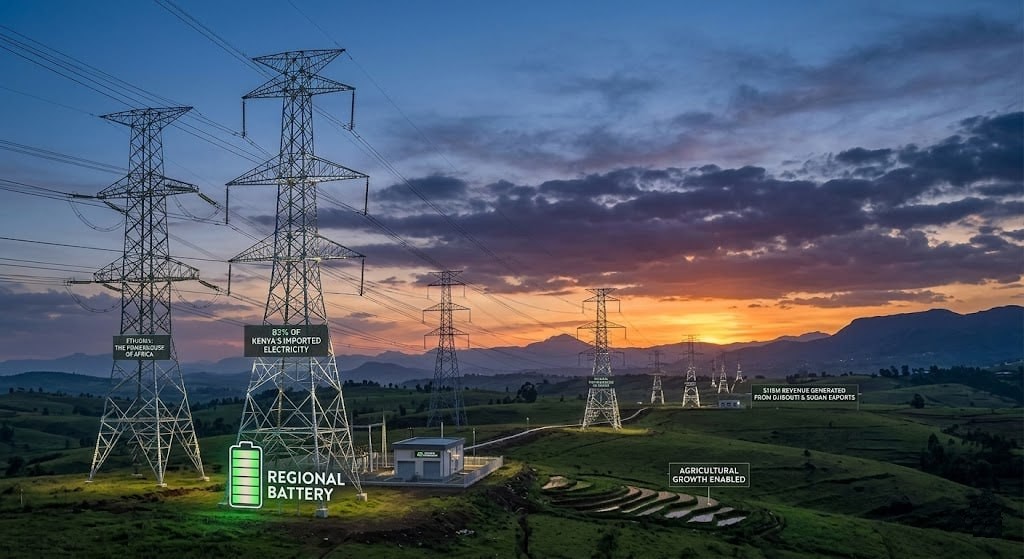
The strategic vision to position Ethiopia as the “Powerhouse of Africa” is being actively realized through its leadership within the Eastern Africa Power Pool (EAPP).
Leveraging its highly advantageous geographical location and naturally abundant resources, our country is serving as a driving force (“engine”) for regional integration in East Africa.
The greatest testament to this monumental success is the Eastern Electricity Highway Project.
The High-Voltage Transmission Line by the Numbers:
- Infrastructure Scale:
- A 1,045-kilometer, bipolar, 500 kV High-Voltage Direct Current (HVDC) transmission line connecting Wolayta Sodo in Ethiopia with Suswa in Kenya.
- Capacity and Investment:
- Completed at an estimated cost of $1.26 billion, this line is capable of transmitting up to 2,000 MW of electricity.
- Primary Supplier to Kenya:
- Ethiopia currently supplies 83 percent of Kenya’s electricity imports. This critical supply has enabled Kenya to replace its expensive, domestically generated thermal power with low-cost energy.
- Cost Efficiency:
- Kenya pays 6.5 cents per kilowatt-hour (kWh) for the electricity it imports from Ethiopia, which is significantly lower than its domestic production cost of 9.4 cents. This clearly demonstrates the tangible impact of regional energy trade in curbing carbon emissions and lowering costs.
Expanding Regional Horizons:
- Beyond the partnership with Kenya, electricity exports to Djibouti and Sudan generated approximately $118 million in revenue during the 2024/25 (2017 EFY) budget year.
- Additional revenue is being secured following the commencement of power sales to Tanzania, while feasibility studies are actively underway to establish energy interconnections with South Sudan and Somalia.
In addition to securing vital foreign currency for our nation, this interconnected power network fosters a highly conducive environment for cultivating “shared wealth and mutual economic strength” across the Horn of Africa, as highlighted by Prime Minister Abiy Ahmed.