
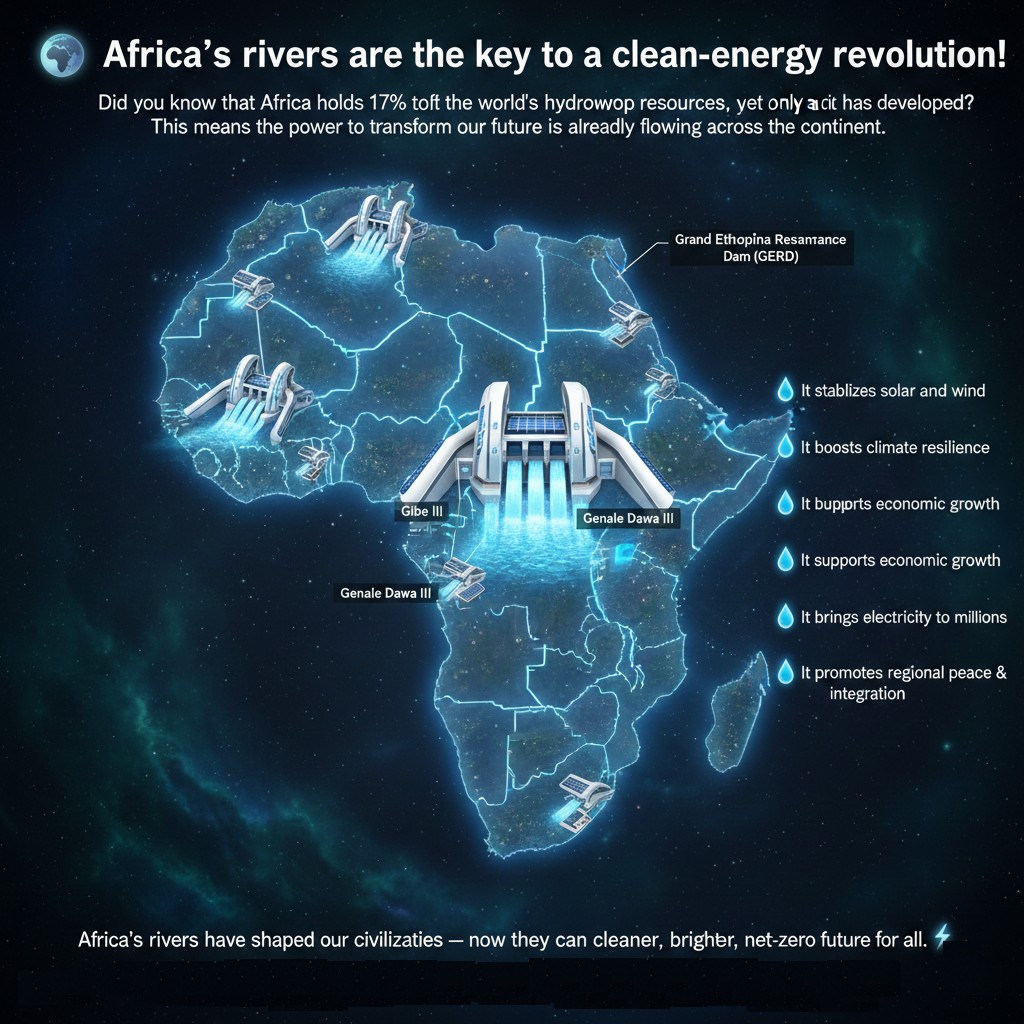
Across the vast expanse of Africa, rivers have long been more than sources of water; they are the continent’s lifeblood, the bearers of history, and the keepers of ecological and cultural memory. Today, these mighty waterways are poised to take on a new role: the foundational force behind Africa’s clean energy transformation. Guided by the vision outlined in the 2025 World Hydropower Outlook, nations are awakening to the immense potential that flows through their landscapes. At the forefront of this movement is Ethiopia, whose ambitious hydropower projects exemplify both the promise and the challenges of harnessing water for energy. This is the story of how Africa is channeling the rhythmic pulse of its rivers to create a symphony of sustainable progress.
The Blueprint for a Renewable Revolution
The 2025 World Hydropower Outlook offers more than data; it presents a vision. It reimagines hydropower not as a relic of early industrialization but as an essential anchor for modern renewable energy systems. In a world racing toward net-zero emissions, hydropower provides the stability needed to integrate variable sources like solar and wind. For Africa—a continent endowed with abundant sunshine, wind potential, and vast untapped hydropower resources—this outlook reads like a prophecy. It suggests that the key to a sustainable, electrified future has always been here, carved into the landscape by rivers such as the Nile, the Congo, and the Zambezi.
Africa’s Untapped Potential: A Continent Awash with Energy
Africa stands at a paradoxical crossroads: rich in renewable energy potential yet plagued by energy poverty. With about 17% of the world’s hydropower resources and a theoretical capacity exceeding 350 gigawatts, the continent holds a vast treasure trove of clean energy. Yet only about 11% of this potential has been developed. This means nearly 90% remains dormant even as over 600 million people live without electricity.
Much of this potential lies in regions where topography channels powerful rivers. The Congo River Basin alone holds a theoretical capacity of around 100 GW—enough to power several nations. The Nile, Zambezi, and Niger offer similar promise. These rivers are not merely natural wonders; they are powerhouses in waiting, capable of fueling industrialization, supporting economic growth, and building climate resilience. The Hydropower Outlook emphasizes that tapping these resources is not just an opportunity but an imperative for Africa’s development.
Ethiopia’s Ambition: The Water Tower of Africa
If Africa is the continent of hydropower promise, Ethiopia is its beating heart. Often called “the water tower of Africa,” Ethiopia’s highlands give rise to rivers with over 45 GW of technically feasible hydropower potential. This immense resource has become central to the nation’s development strategy.
The crown jewel of this ambition is the Grand Ethiopian Renaissance Dam (GERD). Rising over the Blue Nile, the GERD is more than an engineering marvel; it is a symbol of national pride and energy sovereignty. With a planned capacity of 5.15 GW, the dam will double Ethiopia’s electricity generation and position the country as a major energy exporter. Yet GERD is only part of the story. Projects like Gilgel Gibe III, Genale Dawa III, and the Koysha hydropower plant reflect a systematic effort to transform natural wealth into a platform for sustainable progress.
The Present Reality: Progress and Vulnerability
Ethiopia’s hydropower journey has produced significant progress. The national electrification rate has risen from just 15% in the early 2000s to over 50% today, with hydropower providing more than 90% of the country’s electricity. In a typical year, Ethiopian hydropower facilities generate between 15,000 and 16,000 GWh of electricity—an illustration of the transformative power of water.
Yet this heavy dependence reveals a critical vulnerability: climate variability. Recurrent droughts in the Horn of Africa have at times drastically reduced reservoir levels, causing power shortages even with significant installed capacity. This underscores a central message of the 2025 Outlook: sustainable hydropower must also be resilient hydropower. It is no longer enough to build dams; they must be designed and operated with ecological and climatic foresight.
The Symphony of Synergy: Hydropower as the Grid’s Conductor
The true genius of hydropower lies in its ability to enable other renewable energy sources. In a renewable energy symphony, solar and wind are the brilliant but unpredictable soloists—the violins and flutes whose performance depends on the weather. Hydropower, particularly reservoir and pumped-storage systems, is the conductor, providing the steady foundation that allows the entire orchestra to remain in harmony.
This capacity for grid balancing is hydropower’s greatest advantage. It can ramp up or down almost instantly, filling gaps when the sun sets or the wind stills. For nations like Ethiopia, this means hydropower can unlock the potential of geothermal energy from the Rift Valley or solar power from the Danakil Depression, creating a diversified, resilient, and fully renewable energy system. Hybrid approaches—such as floating solar panels on reservoirs or wind farms connected to hydropower-stabilized grids—represent the next frontier in Africa’s energy evolution.
Weaving Sustainability into Development
Harnessing the power of rivers cannot come at the expense of the rivers themselves. The path to a net-zero future must respect the ecosystems and communities that depend on these waterways. The 2025 Outlook calls for a new era of sustainable hydropower projects engineered not only for efficiency but also for ecological and social harmony.
This requires technologies that manage sedimentation, enable fish migration, and ensure minimum environmental flows. It also demands the meaningful engagement of local communities as partners rather than bystanders. Hydropower projects should deliver tangible benefits: electricity for schools and clinics, improved irrigation, flood control, and clean water access. In a continent where community is central to identity, hydropower must become a source of unity and pride.
A Regional Vision: Rivers as Conduits of Cooperation
Many of Africa’s great rivers are transboundary, flowing through multiple nations. This presents both challenges and opportunities. The geopolitical complexities surrounding the Nile illustrate the difficulties—but also the necessity—of regional collaboration. The future of African hydropower depends on stronger power pools and cross-border transmission infrastructure.
Ethiopia’s ambition to become an energy exporter can only be realized through deeper connections with Kenya, Djibouti, Sudan, and other neighbors. When national projects become regional assets, rivers transform from potential flashpoints into conduits of cooperation. Such a regional approach enhances energy security, fosters economic integration, and strengthens shared prosperity.
The Canvas of Tomorrow: From Potential to Luminescence
As the sun sets over the African continent, a new light is beginning to glow—one powered by the flow of its rivers. It is the light of a village school electrified by a micro-hydro plant, the steady hum of a hospital operating theater, and the constellation of homes where children study after dark. This is the future envisioned by the 2025 World Hydropower Outlook: a future where economic growth and environmental stewardship flow together like inseparable currents.
Africa holds the brush to this canvas. Ethiopia has made its first bold strokes, but the masterpiece will require the participation of engineers, ecologists, policymakers, and communities working in harmony. By listening to the ancient wisdom of its waters and combining it with innovation and inclusivity, Africa can create a tapestry of development that is not only net-zero but net-positive for generations to come. The rivers have flowed for eons; now they await their new purpose as architects of light.